
ProtectING residential
property rights
woodland Park
Protecting Residential Neighborhoods in Woodland Park
You Can’t Have a Neighborhood Without Neighbors
Woodland Park spent more than two years discussing short-term rentals, or STRs.
The City asked residents what concerned them. Residents brought forward a Citizens Initiative. City Council offered a different approach. In December 2023, voters considered both proposals and made their choice.
Teller County recently faced many of the same questions. In September 2026, the Board of County Commissioners adopted Ordinance 23 regulating STRs in unincorporated Teller County. The ordinance recognizes that the use of residential homes as STRs has grown over the past decade, even though STRs had never been a permitted land use in Teller County.
The paths taken by Woodland Park and Teller County were different, but both communities wrestled with how STR businesses affect residential neighborhoods. Community leader Jerry Penland has shared a new commentary reflecting on those different paths, the citizen efforts that shaped Woodland Park's STR regulations, and why continued citizen involvement matters.
How Woodland Park’s STR Regulations Came to Be
What Woodland Park Residents Said
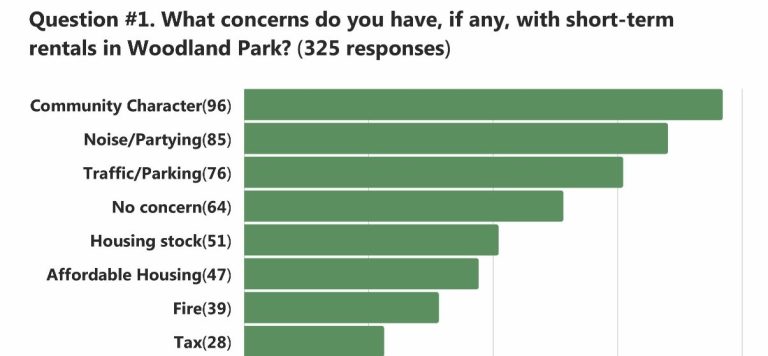
Community Character Was the #1 Concern
In 2022, before any STR regulations were proposed, the City of Woodland Park conducted a community engagement process to better understand residents' views about short-term rentals.
One of the main questions was:
“What concerns do you have, if any, with short-term rentals in Woodland Park?”
Residents answered in their own words. The City reviewed those responses and grouped them by topic.
Community Character was the number one concern.
What Did “Community Character” Mean?
The City explained that Community Character included concerns about:
“lack of neighborliness, degradation of neighborhoods, interruption to daily life, or discomfort/anxiety of not knowing neighbors.”
Noise, parties, parking and trash were concerns. But Community Character ranked above those more traditional STR issues.
The concern was more basic: what happens to a residential neighborhood when whole homes are used as commercial short-term lodging businesses.
Residents were not expressing the same concern about people renting a room or part of the home where they lived. The concern centered on whole homes that were not the owner's primary residence being operated as STR businesses.
When the findings were presented at a joint meeting of City Council and the Planning Commission, the study's author explained this distinction as part of the discussion.
That simple idea became one of the defining messages of the effort to protect Woodland Park's residential neighborhoods.
Read the Full Community Engagement Report
Watch the Joint City Council & Planning Commission Presentation
The Citizens Initiative Drew a Clear Line
The community engagement process did not itself create STR regulations.
But the concern about Community Character helped define the issue that came next.
In 2023, Woodland Park residents brought forward a Citizens Initiative that made a clear distinction between someone's primary residence and a property operated as a non-primary-residence STR business.
The Citizens Initiative did not ban STRs in residential neighborhoods.
People could operate an STR from their primary residence.
But a property that was not the owner's primary residence could not be operated as an STR business in a residential zoning district. Those STR businesses would be located in commercial districts.
Primary Residence
Owner's primary home
↓
STR allowed in residential areas
Non-Primary Residence
Operated as an STR lodging business
↓
Located in commercial areas
Voters Were Given Another Choice
The Citizens Initiative was not the only STR proposal on the December 2023 ballot.
City Council placed a competing proposal before voters.
The Council's approach focused on regulating STRs through measures such as licensing, caps and operating standards. It would have permitted STRs in single-family residential districts, including non-primary-residence STRs, subject to those regulations.
The two proposals therefore offered voters different ways to address the STR issue.
Question 1 — Citizens Initiative
Primary-residence STRs allowed in residential areas
Non-primary-residence STR businesses limited to commercial areas
Addressed where STR businesses should be located
Question 2 — City Council Alternative
STRs allowed in residential areas
Non-primary-residence STRs would be permitted in residential areas, subject to caps and regulations
Focused on regulating the number and operation of STRs
One approach said that operating rules alone were not enough to protect residential neighborhoods.
The other allowed STR businesses to operate in residential areas while regulating how many there could be and how they operated.
Then Woodland Park Voters Decided
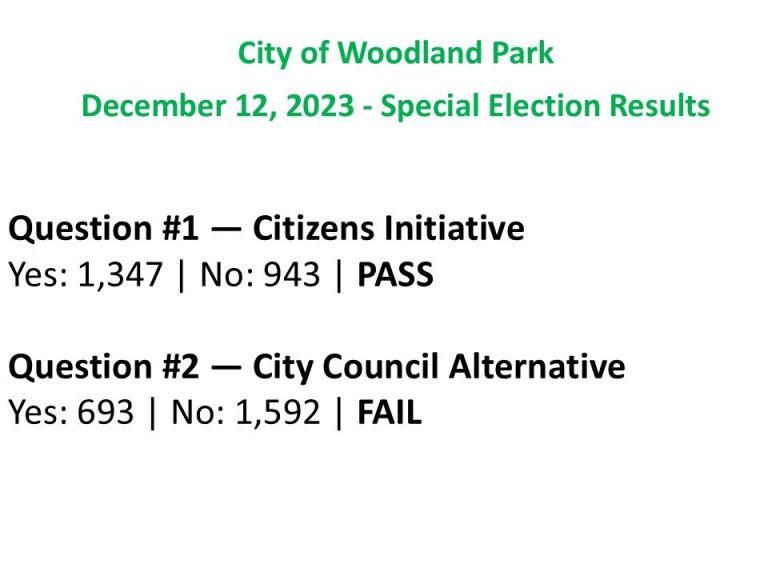
The second result is an important part of Woodland Park's STR history.
It is sometimes said that Woodland Park voters simply approved the Citizens Initiative.
But voters were also given an alternative.
They had the opportunity to approve an approach that would have permitted non-primary-residence STR businesses in residential areas, subject to regulations and limits.
They rejected that alternative by more than two to one.
Voters didn't just approve the Citizens Initiative.
They rejected the alternative.
Why This History Matters Today
Woodland Park and unincorporated Teller County are different jurisdictions.
The 2023 Woodland Park election does not decide what Teller County should do today.
But many of the same questions are being discussed again.
Should the main focus be on controlling noise, parking, trash, occupancy and other problems that can come with STRs?
Or is there also a more basic question:
Should whole homes that are not the owner's primary residence be operated as commercial lodging businesses in residential neighborhoods?
Woodland Park residents spent considerable time considering that question.
The City's community engagement process found that Community Character was the leading concern.
The Citizens Initiative addressed that concern by drawing a line between primary residences and non-primary-residence STR businesses.
Voters then considered two different approaches.
They approved the Citizens Initiative.
And nearly 70% rejected the alternative that would have permitted STRs in residential areas under a different regulatory system.
Woodland Park's decision does not answer the question for Teller County.
But the history is worth knowing.
The Historical Record
We encourage residents, elected officials and others interested in STR policy to review the original records and reach their own conclusions.
City of Woodland Park — 2022 STR Community Engagement Report
Joint City Council & Planning Commission Meeting — Community Engagement Findings
Official December 2023 Special Election Ballot
2023 Special Election Blue Book — Greater Woodland Park Chamber of Commerce
City of Woodland Park STR Ordinances
Teller County - Proposed Ordinance 23 Regulation of Short Term Rentals